2026 Spring Fundraiser for Mosaics

Dear Friends and Supporters of Mosaics,

As Easter reminds us of renewal and hope, we at Intercultural Mosaics—a vibrant ministry proudly sponsored by Davis Community Church—are stepping boldly into a new season of growth and transformation.

With your help, Mosaics has become a safe, creative, and welcoming space where people of all cultures and generations gather in faith, friendship, and purpose. And now, more than ever, we need your partnership to keep that vision alive and expanding.

Our Spring Fundraiser runs through April 19, 2026, and we’re inviting you to be part of something powerful. Our goal is to raise $5,000—a modest amount with mighty potential to shape lives. Whether it’s $5 or $500, your gift will help us:

• Launch innovative hybrid gatherings that unite people online and in-person

• Host cultural nights and fellowship events that promote inclusion and understanding

• Mentor the next generation of diverse, Spirit-led leaders

• Extend radical hospitality to those longing for connection

• Support Mosaics Yolo Compassion Initiative, providing unhoused people meals, sleeping bags and essentials for individuals and families in need

Every dollar counts—and every heart behind it matters even more.

Here is where to donate:

FaceBook Donation Page: https://www.facebook.com/donate/1620534275649808/

If you share our vision and wish to contribute to the growth of our ministries throughout 2025, consider making a tax-deductible love-offering. Simply write your check(s) payable to “Davis Community Church” with a note specifying “Intercultural Mosaics.” Mail your donation to:

Brett Kersten, Minister of Finance, Davis Community Church (c/o Intercultural Mosaics), 412 C Street, Davis, CA 95616

You may also click following “Give Now” button or scan QR Code to give your love-offerings instantly.

Thank you for believing in this ministry and walking this journey with us. Together, we can continue to build a beautiful mosaic of hope, healing, and unity.

With deep gratitude and Easter joy,

Stephen & Grace, Intercultural Mosaics

Share Button

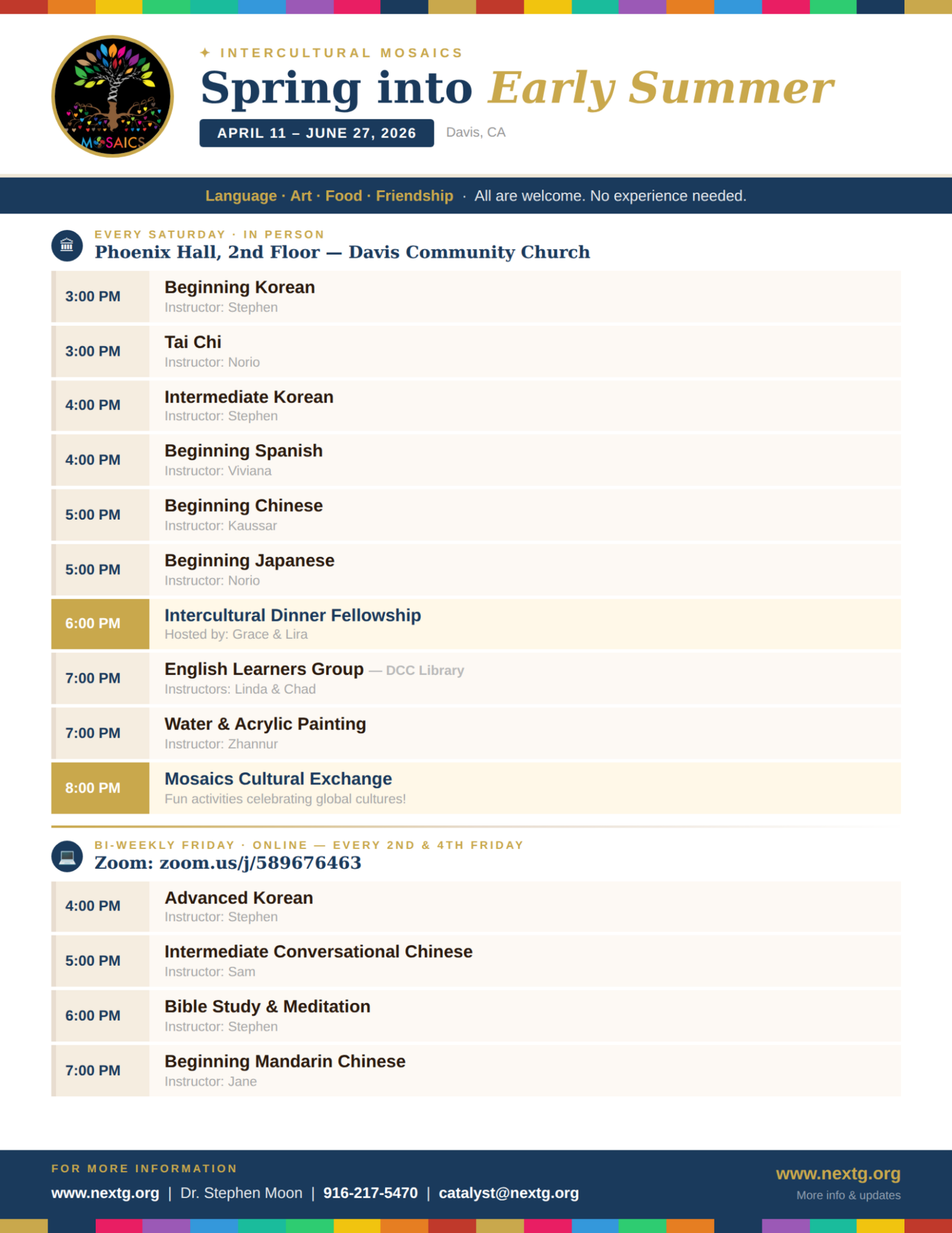
Mosaics Spring into Early Summer Classes

Share Button

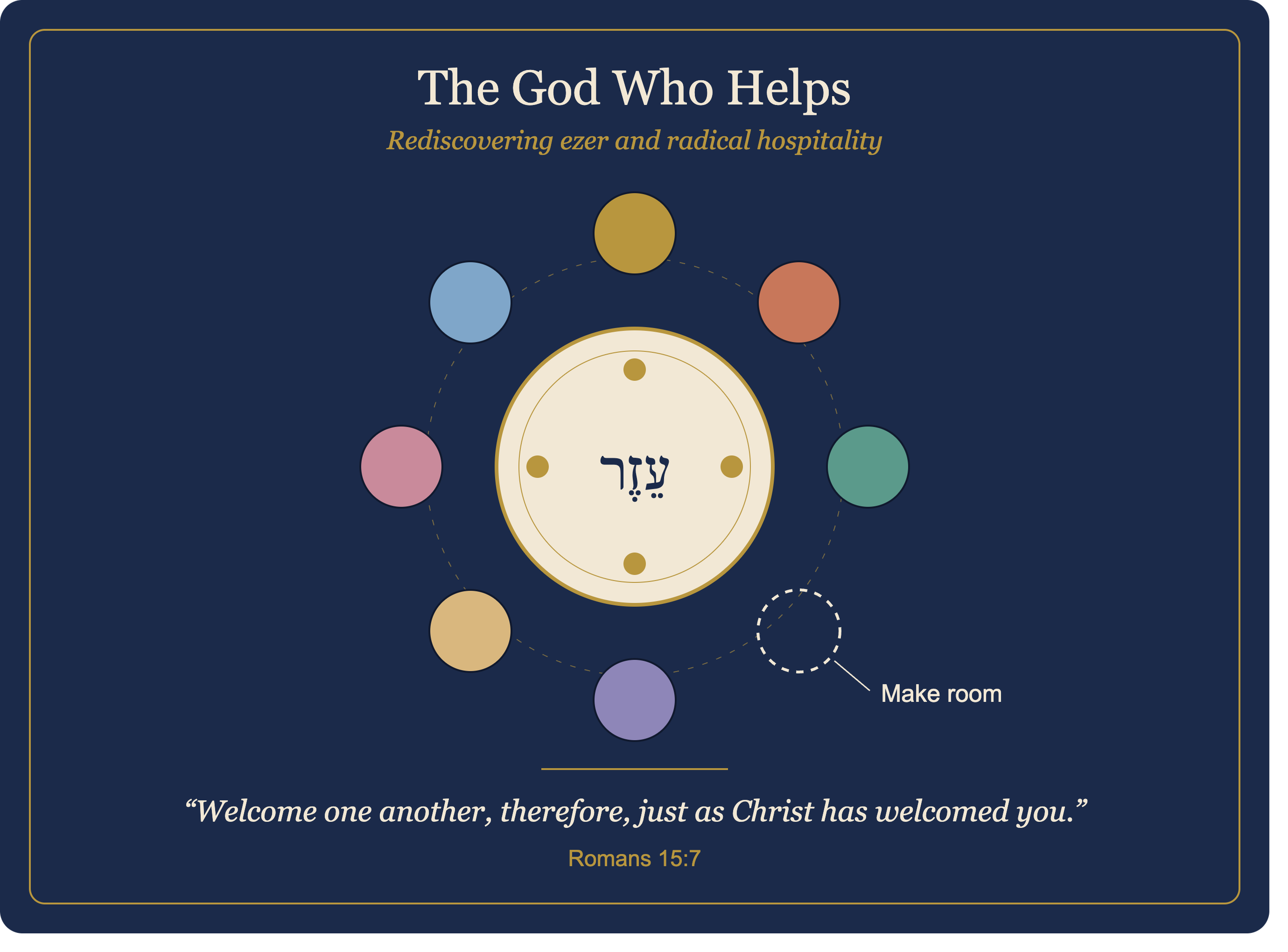
What Is Radical Hospitality — And Why Does It Matter?

What Is Radical Hospitality — And Why Does It Matter?


You’ve probably heard the word “hospitality” before. Maybe it brings to mind a dinner party, a hotel concierge, or a neighbor who drops off cookies when you move in. Nice, right? Warm, even.

But radical hospitality? That’s something different. And if you’re new to intercultural work — or just starting to wonder what it means to truly welcome people unlike yourself — this is the idea we want to introduce you to first. Because it changes everything.


Hospitality Is More Than Being Nice

Regular hospitality says: “You’re welcome here — as long as you fit in.”

Radical hospitality says: “You’re welcome here — full stop.”

The difference sounds small. It isn’t.

Most of us were raised in communities where belonging came with conditions — spoken or not. You belonged if you dressed a certain way, spoke a certain language, held certain values, or came from a certain background. Even well-meaning communities can quietly communicate: we’ll make room for you, but please don’t take up too much space.

Radical hospitality flips that script. It doesn’t just tolerate difference — it actively makes room for it. It’s an ancient idea, actually. The Hebrew word hesed — often translated as “loving-kindness” or “steadfast love” — appears over 200 times in the Old Testament. It describes a love that isn’t earned and can’t be revoked. A love that shows up anyway. That’s the spirit we’re drawing from.


A Biblical Tradition of Welcome

Radical hospitality isn’t a modern invention. It runs like a thread through the entire biblical story.

In Leviticus 19:34, God commands the Israelites: “The foreigner residing among you must be treated as your native-born. Love them as yourself, for you were foreigners in Egypt.” This wasn’t a suggestion — it was a cornerstone of how God’s people were meant to live. Their own experience of displacement was supposed to make them more open to the stranger, not less.

The New Testament pushes this even further. In Matthew 25, Jesus makes a startling claim: when we welcome the stranger, feed the hungry, and care for the vulnerable, we are — whether we realize it or not — welcoming him. “Whatever you did for one of the least of these brothers and sisters of mine, you did for me.” Hospitality, in Jesus’s vision, isn’t charity. It’s encounter with the divine.

The early church took this seriously. Romans 12:13 calls believers to “practice hospitality” — the Greek word used is philoxenia, literally “love of the stranger.” Not tolerance of the stranger. Not management of the stranger. Love.


Where the Word “Radical” Comes In

“Radical” comes from the Latin radix — meaning root. To do something radically is to go all the way down to the root of it, not just scratch the surface.

Radical hospitality isn’t a program or a policy. It’s a posture — a way of orienting yourself toward other people that has to be practiced, not just proclaimed. It asks questions like:

  • Who isn’t in the room yet, and why?
  • Am I making space, or just tolerating presence?
  • What do I need to unlearn in order to truly welcome someone different from me?

These aren’t comfortable questions. But they’re good ones. The prophet Micah summed up the whole of faithful living in three phrases: “Do justice, love kindness, and walk humbly with your God.” (Micah 6:8) Radical hospitality lives at the intersection of all three.


Why It Matters in Intercultural Work

When people from different cultural backgrounds come together, things can get beautifully complicated. Misunderstandings happen. Assumptions get exposed. Sometimes someone says something that lands wrong, or a tradition that feels ordinary to one person feels completely foreign to another.

This is where radical hospitality becomes essential.

Without it, intercultural spaces can default to the dominant culture — where some people feel at home and others are quietly expected to adapt. With it, those moments of friction become opportunities. They become the places where real learning, real trust, and real connection happen.

The book of Acts gives us a stunning picture of what this can look like. At Pentecost, people from every nation heard the good news “each in their own language.” (Acts 2:6) God didn’t ask the crowd to assimilate into one tongue. The miracle was that every language was honored. That’s a vision of unity that doesn’t flatten difference — it celebrates it.

Radical hospitality is what makes a diverse group of people into an actual community.


It’s Not About Agreeing on Everything

Here’s a misconception worth clearing up early: radical hospitality doesn’t mean pretending differences don’t exist, or that every belief and practice is equally valid. It doesn’t mean avoiding hard conversations.

It means that the person — their dignity, their worth, their place at the table — is never up for debate, even when ideas are.

This is rooted in the belief that every human being is made in the image of God — the imago Dei of Genesis 1:27. That’s not a metaphor. It’s a claim about the irreducible worth of every person you will ever meet, regardless of where they’re from, what language they speak, or how different their story is from yours.

You can disagree with someone’s perspective and still honor their humanity. In fact, that capacity — to hold tension without withdrawing welcome — is one of the most important skills in intercultural work. And like any skill, it gets better with practice.


What This Looks Like in Real Life

Radical hospitality can be as grand as redesigning a community event so it’s accessible to people who don’t speak English. Or it can be as small as genuinely asking someone about a holiday you’ve never heard of — and actually listening to the answer.

It looks like:

  • Sitting with discomfort instead of defaulting to what’s familiar
  • Sharing food, stories, and space without needing to be the expert
  • Asking “help me understand” instead of “let me explain”
  • Showing up consistently, not just when it’s convenient

Jesus modeled this consistently. He crossed every social boundary of his day — eating with tax collectors, speaking with Samaritan women, touching those considered untouchable. His table was famously, scandalously open. Ours can be too.

None of this requires special training or a degree in cultural studies. It requires curiosity, humility, and the willingness to keep showing up — even when it’s awkward.


Why We Built Something Around This Idea

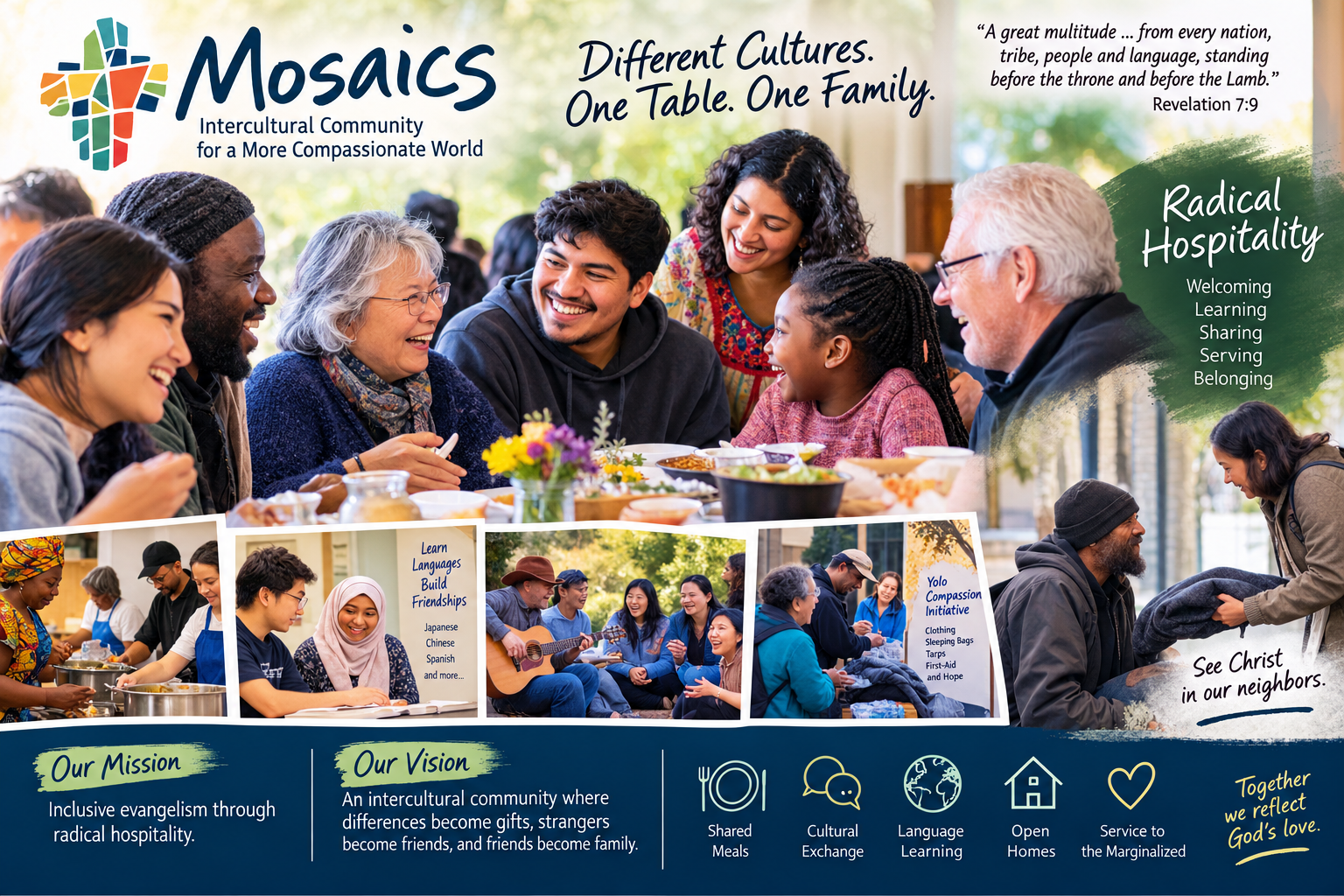
At the Yolo Compassion Initiative — a project of Intercultural Mosaics, right here in Davis, CA — radical hospitality isn’t a tagline. It’s the foundation everything else is built on.

We believe that Yolo County is richer because of its cultural diversity. We also believe that diversity alone isn’t enough — proximity isn’t the same as connection. People can live side by side for years without ever truly seeing each other.

We exist to close that gap. Through community gatherings, shared meals, storytelling, and honest conversation, we’re creating spaces where people don’t just coexist — they belong to each other. We’re taking seriously the vision of Revelation 7:9 — a community made up of “every nation, tribe, people and language” — and trying to live a little piece of it right here, right now, in our own corner of California.

And it starts with a simple, radical idea: everyone gets a seat at the table.


Ready to Practice Radical Hospitality?

Whether you’re new to intercultural work or you’ve been at it for years, there’s always more to learn — and more room to grow.

We’d love to have you join us. Follow us on social media, come to an event, or just reach out and say hello. The door is open. It always is.

— Yolo Compassion Initiative, a project of Intercultural Mosaics | Davis, CA


Want to share this article? Tag us and use #RadicalHospitality #YoloCompassionInitiative — we’d love to see it spread.

Share Button

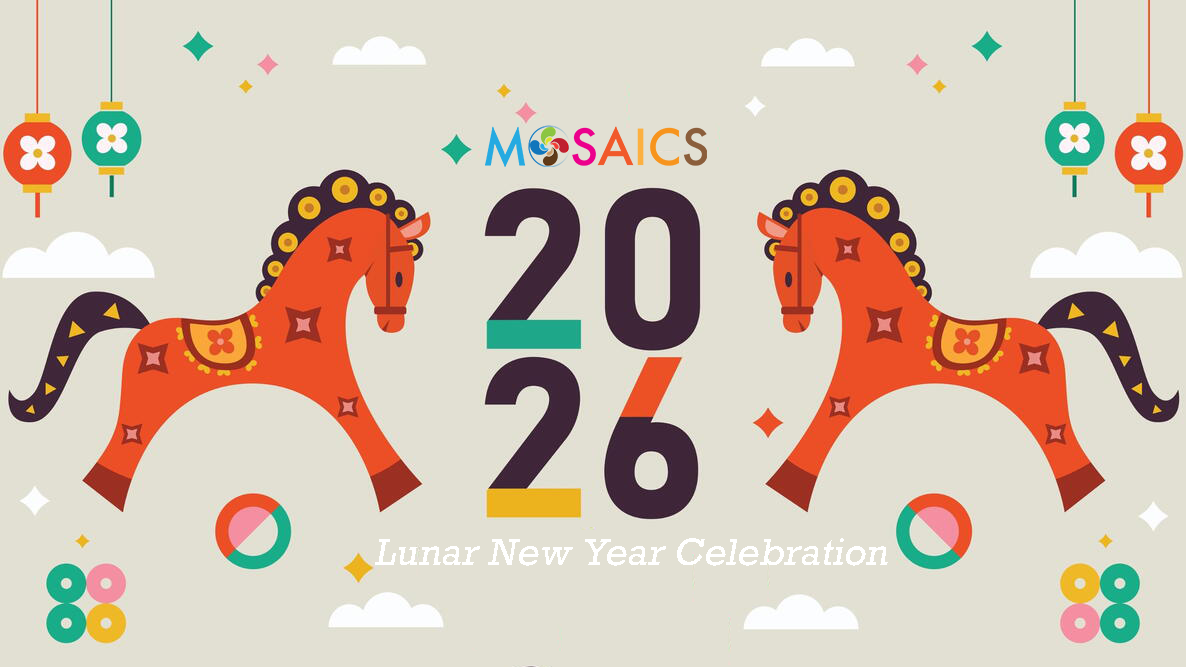
Mosaics 2026 Lunar New Year Celebration

Intercultural Mosaics 12th Lunar New Year Celebration

Join Intercultural Mosaics for our 12th Lunar New Year Celebration on Saturday, February 14, 2026, at the 2nd floor of Phoenix Hall, Davis Community Church.

Cooking Classes: 4:00 PM – Learn to make a variety of delicious Korean pancakes and other dishes

Dinner: 6:00 PM – Enjoy traditional Korean and Asian Lunar New Year dishes and desserts.

Bring your friends and family for an evening full of food, music, and fun games as we celebrate the Lunar New Year together!

For more information, contact Dr. Stephen Moon at 916-217-5470.

Share Button

Mosaics Winter 2025-2026 Class Schedule

Discover Intercultural Mosaics This Winter 2025–2026!

Join us for a vibrant and uplifting season of virtual learning and community from December 20, 2025 to March 28, 2026—all from the comfort of your home on Zoom!

Zoom Link: https://zoom.us/j/589676463

Bi-Weekly Friday Zoom Sessions (Every 2nd and 4th Friday)

4:00 PM – Advanced Korean with Stephen
5:00 PM – Intermediate Conversational Chinese with Sam
6:00 PM – Bible Study & Meditation Group with Stephen
7:00 PM – Beginning Chinese with Jane

Weekly Saturday Zoom Sessions (total of 12 sessions)

4:00 PM – Beginning Spanish with Viviana
5:00 PM – Beginning to Intermediate Korean with Stephen
6:00 PM – Beginning to Intermediate Japanese with Norio
7:00 PM – English Learners Group with Linda & Chad

Important Notes

  1. No Zoom sessions on January 2–3, 2026 (New Year) and April 3–4, 2026 (Easter).
  2. Special Gatherings (Tentative):
    February 14, 2026: Valentine’s Day & pre–Lunar New Year celebration in person at Phoenix Hall, 2nd Floor, Davis Community Church.
    March 14, 2026: Additional in-person gathering (tentative).
  3. Return to In-Person Meetings:
    We will resume our regular in-person gatherings on April 11, 2026 at the 2nd floor rooms of Phoenix Hall, Davis Community Church.

For more information about Intercultural Mosaics classes and activities, visit www.nextg.org or contact Dr. Stephen Moon at 916-217-5470 or catalyst@nextg.org.

Share Button

Advent Greetings from Intercultural Mosaics

Advent Greetings from Intercultural Mosaics

2025 Year-End Fundraiser: Help Us Reach $7,000

As candles of hope are lit across the world this Advent season, we invite you into a story of light that is quiet, powerful, and full of possibility.

Intercultural Mosaics was born from a simple, sacred dream: that people of every culture, generation, language, and journey could gather — not as strangers, but as one beautifully woven community. Each person, each story, each culture is a living piece of a greater mosaic of hope.

In 2025, that dream continues to grow.

This year, our prayerful goal is to raise $7,000 to expand our work of:

  • Building inclusive, intercultural gatherings
  • Supporting immigrant and diasporic communities
  • Providing meals, bicycle access, and essential care to our unhoused neighbors
  • Creating safe, creative spaces for youth, families, and elders
  • Developing leadership for the next generation of peacemakers

Your gift is more than a donation — it is a light in someone’s winter.
Whether it’s $10, $50, $100, or $1,000, every contribution becomes a thread of kindness, dignity, and belonging.


Ways to Give

Give Online: https://www.facebook.com/donate/1395050998701324/

Click the “Give Now” button or scan the QR code.

Please click following “Give Now” button or scan QR Code to give your love-offerings instantly.

Give by Mail:
Make checks payable to: Davis Community Church
(Memo: Intercultural Mosaics)

Mail to:
Brett Kersten, Minister of Finance
Davis Community Church
c/o Intercultural Mosaics
412 C Street
Davis, CA 95616

All donations are tax-deductible.


As we walk together through this season of expectation, may your generosity become part of the miracle we are building — one meal, one conversation, one life at a time.

Thank you for being a cherished partner in this journey.

With gratitude and hope,

Rev. Dr. Stephen Moon
Intercultural Mosaics

#InterculturalMosaics #AdventGiving #GratefulHearts #TogetherWeRise #LightInTheDarkness

Share Button

2025 Mosaics Thanksgiving Feast

Mosaics Thanksgiving Feast 2025

Join us for a heartwarming evening of gratitude, community, and celebration!

• When: 6 pm, Saturday, November 22, 2025

• Place: Phoenix Hall (2nd Floor), Davis Community Church

We’ll begin with our regular Mosaics classes, then gather at 6:00 pm for a joyful Thanksgiving Feast filled with laughter, love, and delicious food. Come hungry for a traditional turkey dinner and bring your favorite homemade dish, dessert, or drink to share with friends old and new!

Karaoke Fun & Prizes! 
After dinner, take the stage (or cheer from the crowd!) as we celebrate the joy of music. Sing your heart out for a chance to win a special karaoke prize — everyone’s welcome, from seasoned performers to shower singers!

Volunteers Needed!
Help us make the evening extra special — join us at 2:30 pm to decorate, assist in the kitchen, or lend a hand with cleanup. Together, let’s create a warm and festive space where gratitude and friendship shine.

For more information, contact Dr. Stephen Moon at 916-217-5470.
Let’s gather, give thanks, and celebrate this beautiful season together! 

Share Button

When God Turns Back Time: Lessons from Hezekiah’s Healing

When God Turns Back Time: Lessons from Hezekiah’s Healing

Scriptures: 2 Kings 20:1-11 | Isaiah 38:9-20 | 2 Corinthians 4:16–18 | Philippians 4:6-7

1 In those days Hezekiah was sick and dying. Isaiah the prophet the son of Amoz came to him, and said to him, “Yahweh says, ‘Set your house in order; for you will die, and not live.’”

Then he turned his face to the wall, and prayed to Yahweh, saying, “Remember now, Yahweh, I beg you, how I have walked before you in truth and with a perfect heart, and have done that which is good in your sight.” And Hezekiah wept bitterly.

Before Isaiah had gone out into the middle part of the city, Yahweh’s word came to him, saying, “Turn back, and tell Hezekiah the prince of my people, ‘Yahweh, the God of David your father, says, “I have heard your prayer. I have seen your tears. Behold, I will heal you. On the third day, you will go up to Yahweh’s house. I will add to your days fifteen years. I will deliver you and this city out of the hand of the king of Assyria. I will defend this city for my own sake, and for my servant David’s sake.”’”

Isaiah said, “Take a cake of figs.”

They took and laid it on the boil, and he recovered.

Hezekiah said to Isaiah, “What will be the sign that Yahweh will heal me, and that I will go up to Yahweh’s house the third day?”

Isaiah said, “This will be the sign to you from Yahweh, that Yahweh will do the thing that he has spoken: should the shadow go forward ten steps, or go back ten steps?”

10 Hezekiah answered, “It is a light thing for the shadow to go forward ten steps. No, but let the shadow return backward ten steps.”

11 Isaiah the prophet cried to Yahweh; and he brought the shadow ten steps backward, by which it had gone down on the sundial of Ahaz.

The story of King Hezekiah’s sickness and healing is more than a historical account—it is a living testimony of prayer, repentance, and God’s mercy.

When Isaiah first told Hezekiah, “Set your house in order, for you shall die,” it was both a practical and spiritual call. Practically, it meant to arrange succession, settle debts, and reconcile relationships. Spiritually, it was a reminder to be ready to meet God at any moment.

But Hezekiah turned his face to the wall and prayed. He poured out his heart: “Remember how I have walked before you faithfully.” With tears streaming down his face, he prayed an honest, raw, tearful prayer. And God listened. Psalm 34:7 assures us: “The righteous cry out, and the Lord hears.”

God’s answer was immediate: “I have heard your prayer, I have seen your tears; behold, I will heal you.” On the third day, Hezekiah would rise and return to the temple. The “third day” points us to decisive restoration, echoing Hosea 6:2 and anticipating the resurrection hope in Christ.

God added fifteen years to Hezekiah’s life—not only for him but for the sake of Jerusalem, giving time for repentance and fulfilling His covenant promise to David. This reminds us that one person’s prayer, one person’s repentance, can shape the destiny of a whole community.

The healing came through both divine word and practical means: Isaiah instructed the use of a cake of figs on the infection. God often works through both supernatural power and ordinary remedies.

When Hezekiah asked for a confirming sign, God gave him something astounding: the sundial’s shadow moved backward ten steps. Time itself seemed to reverse, a supernatural sign of God’s mercy. The death sentence was lifted; life was restored.

In Isaiah 38, Hezekiah’s song reflects his inner journey:

The writing of Hezekiah king of Judah, when he had been sick, and had recovered of his sickness:

10 I said, “In the middle of my life I go into the gates of Sheol.[a]
    I am deprived of the residue of my years.”
11 I said, “I won’t see Yah,
    Yah in the land of the living.
    I will see man no more with the inhabitants of the world.
12 My dwelling is removed,
    and is carried away from me like a shepherd’s tent.
I have rolled up my life like a weaver.
    He will cut me off from the loom.
    From day even to night you will make an end of me.
13 I waited patiently until morning.
    He breaks all my bones like a lion.
    From day even to night you will make an end of me.
14 I chattered like a swallow or a crane.
    I moaned like a dove.
    My eyes weaken looking upward.
    Lord, I am oppressed.
    Be my security.”
15 What will I say?
    He has both spoken to me, and himself has done it.
    I will walk carefully all my years because of the anguish of my soul.
16 Lord, men live by these things;
    and my spirit finds life in all of them.
    You restore me, and cause me to live.
17 Behold, for peace I had great anguish,
    but you have in love for my soul delivered it from the pit of corruption;
    for you have cast all my sins behind your back.
18 For Sheol[b] can’t praise you.
    Death can’t celebrate you.
Those who go down into the pit can’t hope for your truth.
19 The living, the living, he shall praise you, as I do today.
    The father shall make known your truth to the children.
20 Yahweh will save me.
    Therefore we will sing my songs with stringed instruments all the days of our life in Yahweh’s house.”

  • Despair: “My dwelling is pulled up and removed from me like a shepherd’s tent.”
  • Reflection: “Surely it was for my welfare that I had great bitterness.” Through suffering, he was humbled, drawn closer to God, and granted deeper wisdom.
  • Renewal: “We will sing to the Lord all the days of our lives.” His healing led to a vow of lifelong worship and communal celebration.

This story invites us to connect with our own journeys. Just as Hezekiah turned his face to the wall in prayer, we are called to turn to God with honesty and tears. Just as God restored Hezekiah, He can bring renewal to our lives and our communities.

The New Testament shines light on this story:

  • 2 Corinthians 4:16–18 reminds us that though our bodies may waste away, God is renewing us inwardly, preparing eternal glory.

“Therefore we don’t faint, but though our outward person is decaying, yet our inward person is renewed day by day. For our light affliction, which is for the moment, works for us more and more exceedingly an eternal weight of glory, while we don’t look at the things which are seen, but at the things which are not seen. For the things which are seen are temporal, but the things which are not seen are eternal.”

  • Philippians 4:6–7 echoes Hezekiah’s desperate prayer: in every situation, by prayer and thanksgiving, we find peace that guards our hearts in Christ Jesus.

“In nothing be anxious, but in everything, by prayer and petition with thanksgiving, let your requests be made known to God. And the peace of God, which surpasses all understanding, will guard your hearts and your thoughts in Christ Jesus.”

The God who heard Hezekiah’s prayer and turned back time is the same God who hears us today. He is the God of second chances, the God who heals, the God who restores.

Summary: Lessons from Hezekiah’s Healing

  • Set your house in order – Practical & Spiritual readiness (2 Kings 20:1)
  • Turn to the wall – Honest, tearful prayer moves God’s heart (vv. 2-3)
  • God hears & heals – ‘I have heard your prayer, I have seen your tears’ (vv. 4-5)
  • Third day restoration – Echo of resurrection hope (Hosea 6:2)
  • Fifteen more years – God ties personal healing to national rescue (v. 6)
  • Healing through both divine word & practical means (V. 7)
  • A sign from God – Sundial shadow reversed, time turned back (vv. 8-11)
  • Hezekiah’s song – From despair to thanksgiving (Isaiah 38:9-20)
  • NT light – Renewed inwardly (2 Cor. 4:16-18), peace in prayer (Phil. 4:6-7)

Key Truth: The God who heard Hezekiah’s tears is the same God who hears us today.

Share Button

A Testimony of Healing and Gratitude

A Testimony of Healing and Gratitude

by Rev. Dr. Stephen Moon

Dear friends in Christ,

I want to share my heart with you and give glory to God for what has been done in my life over the past three months. It began with something as small as gum infections, but quickly spread to my eyes, ears, sinuses, and even across the skin of most of my body. My immunity was almost down to zero when the symptoms started. I found myself fighting with four different medications, struggling through sleepless nights, and wondering if I would ever recover.

During this time, I drew blood several times to check my vitals, and my family doctor grew increasingly worried. There was even concern that I might actually be showing symptoms of leukemia. I will never forget the day my wife, Grace, cried at the doctor’s office when she heard the possibility that I might have to face such a diagnosis. In those weeks, I lost nearly 10 pounds through July and August, as my body grew weaker and my spirit more burdened. By the grace of God, I have since regained my strength and restored the weight I lost—a living reminder of renewal.

In the middle of that valley, when I was exhausted in body and spirit, your prayers became a lifeline. Pastors and friends in our presbytery reached out with love and encouragement, and I cannot thank you enough. Every message, every whispered prayer, every word of support reminded me that I was not walking this path alone.

Through this trial, the Lord gently taught me to let go of the thousands of stresses and worries I had been carrying. Instead, my eyes were opened to one central truth: that life and healing are in God’s hands. I began to see more clearly than ever that my hope rests not in medicine alone, but in the Lord who is both Shepherd and Healer.

By God’s mercy, I have been restored. God has heard our prayers and lifted me from the brink. Today, I can say with the psalmist: “I cried out to You for help, and You healed me. You, Lord, brought me up from the realm of the dead” (Psalm 30:2–3).

I am overflowing with gratitude—for renewed health, for the chance to continue serving, and especially for the loving community of pastors and friends who surrounded me with such faithful care. Truly, I have experienced God’s healing power through your prayers.

I also want to offer a word of encouragement to my fellow pastors: please take time to relax and allow yourselves a good sabbatical break. Maintaining your health is vital for serving God and others without interruption. Do not wait until crisis forces you to stop—make space now to be renewed, so your ministry may flourish with strength and joy.

Thank you, my dear brothers and sisters, for standing with me in this storm. May my testimony be a reminder that even in our darkest moments, the Lord still listens, still heals, and still brings us into new life.

With heartfelt gratitude and joy,

Stephen

Share Button

Intercultural Mosaics: Spotlight for DCC’s Capital Campaign

Intercultural Mosaics: Spotlight for DCC’s Capital Campaign

Shaping a Thriving, Transformational Community

For ten years, Intercultural Mosaics has been more than a ministry—it is a Spirit-led movement and a leading example of radical hospitality. Our mission is simple yet profound: to nurture transformed lives that radiate hope, renew neighborhoods, and embody God’s reconciling love. Through worship and discipleship, intercultural friendships, and holistic community care, Mosaics has become a spiritual ecosystem. Here, diverse generations and cultures grow together in faith.

Resilience, Recovery, and Renewal

  • Before 2020: We welcomed over 1,500 unique participants, with 3–7 new guests joining each week.
  • 2020–2022: Fully online during the pandemic, reaching more than 1,000 people with steady weekly engagement of 75–100.
  • Since 2023: Mosaics has re-emerged as a vibrant hybrid community, gathering in Davis and Sacramento homes, at Phoenix Hall on the DCC campus, and globally online.
  • Today: 300+ active members representing more than 30 cultures, witnessing together to God’s transforming grace.

Expanding Reach

  • 6,395 events since inception, welcoming 3,226 participants.
  • A digital presence including 49,734 website subscribers and 315 active Facebook members.
  • Over 200 new participants in 2024–25—a clear sign of sustained spiritual curiosity and growth.

Caring for Our Neighbors

In April 2025 we launched the Mosaics Food Security Initiative, offering meals and free bicycle repair for unhoused and under-resourced neighbors. Building on this success—and with pending Synod support—we are preparing the Mosaics Yolo Compassion Initiative, a whole-person care project offering nourishment, emotional healing, and practical pathways to wellness.

Partnering for Impact

Looking ahead, we face significant financial challenges. Several grants that have sustained our work are expected to diminish in the coming years. Our annual budget of $100,000 requires an additional $20,000–$30,000 to maintain and expand our ministry.

Currently, about 40% of our budget comes from Facebook fundraisers, major donors, and the faithful giving of Mosaics participants and supporters. The remaining 60% comes from grants and partner churches within our presbytery.

Davis Community Church, as our cherished partner and sponsoring congregation, has the opportunity to help shape the next chapter of Intercultural Mosaics through your upcoming capital campaign. Your generosity will empower these ministries to thrive—bringing hope, transformation, and lasting impact to lives and communities for generations to come.

Looking to the Next Decade

As we celebrate a decade of God’s faithfulness, we envision the next ten years as a season of deeper healing, stronger friendships, and transformative discipleship across cultures and generations. Your support will help us bring this vision to life.

Voices of Transformation

Behind these numbers are real people whose lives have been transformed—here are their stories.

A Place of Belonging and Support

“When I was a new mother, Davis Mosaics connected me and my kids with a diverse, caring community. We experienced languages, cultures, and food from around the world.” – Amy Corona

Learning, Friendship, and Hope

“Mosaics allowed me to study French, Spanish, and American Sign Language, and to teach German. Sharing dinner with new friends helped me feel part of a community. You go home happier, smarter, and less alone.” – Honna Steissberg

Faith in Action

“Grace and Stephen Moon have given to me and to the community the highest gift of love— selfless service and dedication. I feel blessed to be part of such a beautiful network of friends and families where everyone is welcomed.” – Amber Weber

Transformation and New Life

“They say find the ‘friendly face in the crowd,’ but I found more than that. My life was changed, and I will forever be grateful. Davis Mosaics felt like home from day one.” – Rocio Corona

Cross-Cultural Community

“As a Malian, I came to Davis with different cultures and beliefs. Mosaics helped me interact with people and see the beauty of cultural difference. Kindness is the best way of communication between humans. Mosaics is family.” – Aïssata Sow

Spiritual Growth and Fellowship

“I began attending Mosaics Bible Study in 2016. Since then, I have gained a deeper understanding of the Bible and the teachings of Jesus Christ. Having no family of my own, I have always felt welcomed by Pastor Stephen and his wife Grace as part of the Intercultural Mosaics family.” – Robert Richardson

A Treasured Community Resource

“They have truly created a beautiful environment where people of all walks of life come, learn, laugh, play music, and feel accepted. Mosaics has become one of the most treasured resources in our city.” – Stephanie Thayer

Through stories like these, Intercultural Mosaics shows that it is not merely a program—it is a lifeline of learning, fellowship, and hope. With your partnership, this ministry will continue to grow, bringing together people from around the world to experience love, belonging, and transformation.

Together, let us invest in a future where God’s reconciling love reaches every neighbor and every nation—starting right here in Davis.

“See, I am doing a new thing! Now it springs up; do you not perceive it? I am making a way in the wilderness and streams in the wasteland.”Isaiah 43:19

“They devoted themselves to the apostles’ teaching and fellowship, to the breaking of bread and the prayers… And the Lord added to their number daily those who were being saved.”Acts 2:42–47

Share Button

Living the Way Together, Putting Faith in Action