

The Future Church Needs an Integrated Security Ecosystem
Protecting Sacred Communities Both Physically and Digitally
The future church will no longer function only as a physical gathering space. It is rapidly becoming a hybrid ecosystem that exists simultaneously in sanctuaries, homes, streets, campuses, cloud networks, livestreams, mobile devices, AI platforms, counseling spaces, and global intercultural communities.
As ministry expands beyond walls, the meaning of security must also expand.
The church of the future needs more than cameras, locks, passwords, or cybersecurity software. It needs a holistic and adaptive security ecosystem specifically designed for faith communities — one that protects people spiritually, emotionally, physically, relationally, ethically, and digitally.
This is not merely a technology issue.
It is a stewardship issue.
A trust issue.
A discipleship issue.
Redefining Church Security for the Future
Traditional church security often focused only on physical protection:
- Locks on doors
- Alarm systems
- Security teams
- Emergency evacuation plans
Later, churches added limited digital protection:
- Password-protected giving systems
- Wi-Fi security
- Website management
- Online streaming moderation
But future churches face far more complex realities.
Today’s ministry environments include:
- AI-generated misinformation
- Digital impersonation
- Data privacy threats
- Online harassment
- Financial scams
- Child safety concerns
- Cyberattacks
- Political extremism
- Mental health crises
- Intercultural misunderstandings
- Hybrid worship vulnerabilities
- Volunteer access management
- Global communication risks
The future church requires an integrated security ecosystem that is:
- Human-centered
- Ethically grounded
- Interculturally aware
- Spiritually responsible
- Technologically adaptive
- Community-based
- Open yet protected
A Church-Specific Security Ecosystem
Unlike corporate security systems designed primarily for profit and enterprise control, church security must reflect the mission and values of faith communities.
The purpose of church security is not merely control.
Its purpose is:
- Protection
- Hospitality
- Trust
- Care
- Integrity
- Stewardship
- Human dignity
- Community flourishing
A church-specific security ecosystem must therefore cover both:
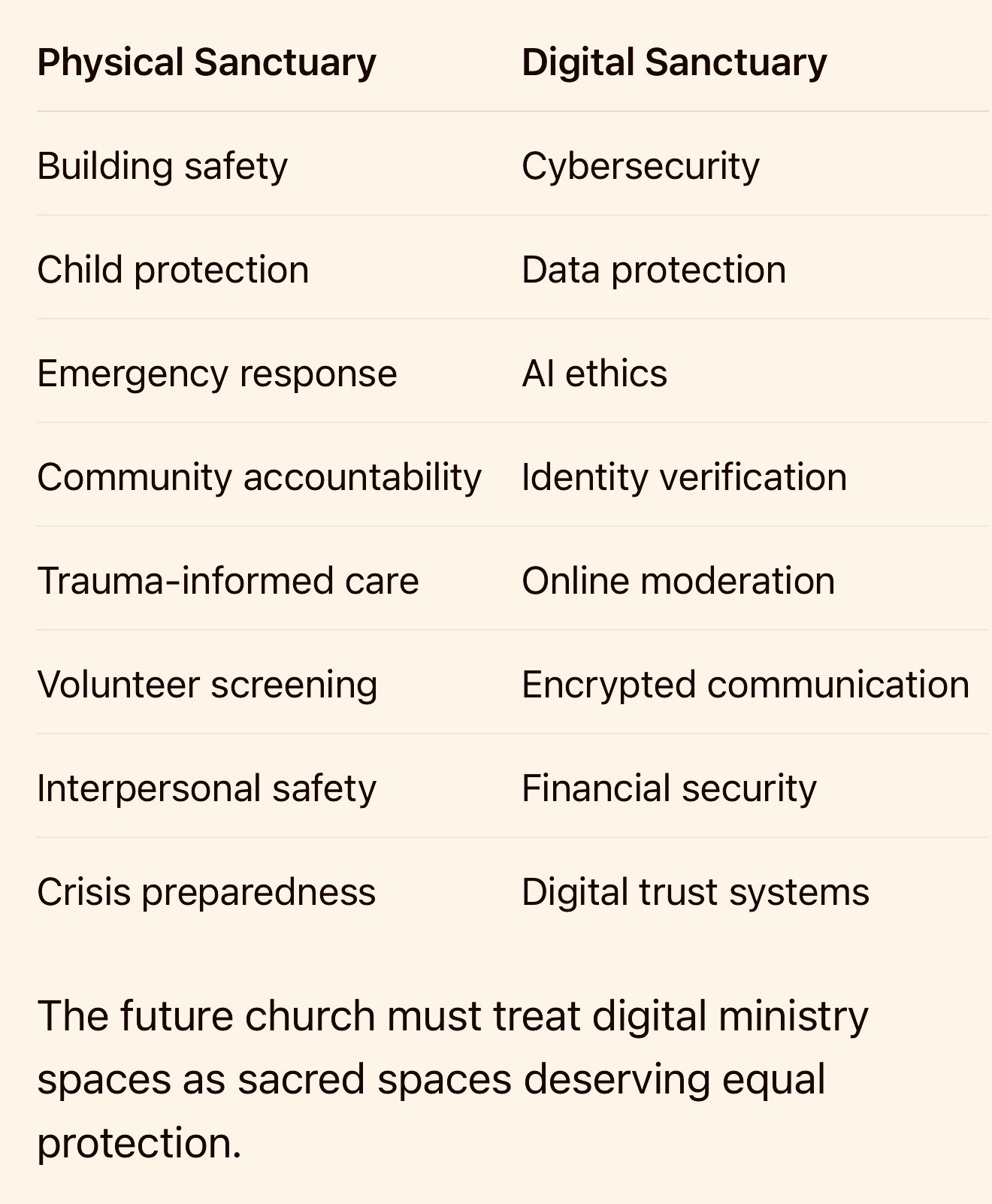
The Future Church as a Hybrid Sanctuary
Historically, churches were sanctuaries — places of refuge, safety, healing, and belonging.
In the future, churches must become:
Hybrid Sanctuaries
A hybrid sanctuary protects people:
- In person
- Online
- Emotionally
- Financially
- Spiritually
- Socially
- Culturally
People must feel safe:
- Attending worship physically
- Joining Zoom Bible studies
- Giving online
- Sharing prayer requests
- Seeking counseling
- Participating in youth ministry
- Engaging through AI-assisted systems
Trust is the foundation of ministry.
Without trust, communities fragment.
Why Open Ecosystems Matter
Many institutions respond to security threats by becoming closed, rigid, and highly centralized.
But churches thrive through:
- Relationships
- Collaboration
- Volunteer participation
- Creativity
- Intercultural exchange
- Shared leadership
- Community innovation
The future church therefore needs:
Secure Openness
This means:
- Strong protections without isolation
- Innovation without chaos
- Collaboration without vulnerability
- Flexibility without losing accountability
A healthy church ecosystem should allow:
- Third-party ministry tools
- Open-source collaboration
- AI-assisted ministry systems
- Community-created content
- Interchurch partnerships
- Multilingual digital environments
- Decentralized ministry leadership
Security should empower ministry, not suffocate it.
Layers of Future Church Security
1. Physical Security
Future churches must prepare for:
- Medical emergencies
- Violence prevention
- Fire and disaster response
- Homeless outreach safety
- Child and elder protection
- Trauma-informed crisis care
- Safe transportation ministries
- Facility monitoring systems
Security teams should be trained not only in defense, but also:
- Compassion
- De-escalation
- Mental health awareness
- Cultural sensitivity
2. Digital Security
Churches increasingly hold sensitive information:
- Financial records
- Counseling communications
- Immigration-related concerns
- Prayer requests
- Volunteer databases
- Youth information
- Livestream systems
Future churches need:
- Multi-factor authentication
- Secure cloud systems
- Encrypted communication
- Access-level permissions
- Cybersecurity education
- AI governance policies
- Secure donation systems
- Data transparency standards
Digital stewardship is now part of pastoral responsibility.
3. Relational Security
One of the greatest threats to churches is not technological failure but relational breakdown.
Future churches need systems that strengthen:
- Accountability
- Transparency
- Conflict resolution
- Abuse prevention
- Emotional safety
- Healthy leadership culture
Relational trust is foundational infrastructure.
4. Intercultural Security
Intercultural ministries face unique vulnerabilities:
- Language barriers
- Immigration fears
- Generational divides
- Financial exploitation
- Cultural misunderstandings
- Different digital literacy levels
Future churches must provide:
- Multilingual education
- Accessible technology
- Inclusive communication systems
- Cross-cultural mediation
- Ethical hospitality practices
Security must never become exclusionary.
AI and the Church
Artificial intelligence will reshape ministry dramatically:
- Sermon preparation
- Translation
- Counseling support
- Administration
- Discipleship pathways
- Community analysis
- Worship technologies
But AI also introduces risks:
- Deepfakes
- Misinformation
- Manipulation
- Surveillance abuse
- Loss of authenticity
- Algorithmic bias
Future churches need:
Ethical AI Governance
This includes:
- Human oversight
- Transparency
- Consent
- Accountability
- Bias awareness
- Spiritual discernment
Technology should assist ministry, not replace humanity.
The MOSAICS Framework for Future Church Security
M — Multilayer Protection
Physical, emotional, relational, financial, and digital security working together.
O — Open Collaboration
Safe innovation through partnerships, shared leadership, and interoperable systems.
S — Sanctuary Culture
Creating environments where people experience safety, dignity, and belonging.
A — AI Ethics
Ensuring technology serves people responsibly and transparently.
I — Intercultural Accessibility
Designing systems for multilingual, multicultural, and multigenerational communities.
C — Community Accountability
Building transparent leadership and trust-centered governance.
S — Spiritual Discernment
Keeping mission, compassion, and wisdom above technological obsession.
The Future Church Must Become Trust Infrastructure
In an age of fragmentation, misinformation, loneliness, and distrust, churches may become one of the few remaining places where people seek authentic community and trustworthy relationships.
But trust cannot survive without protection.
The future church must become:
- Spiritually grounded
- Digitally responsible
- Physically prepared
- Emotionally intelligent
- Ethically transparent
- Interculturally adaptive
The strongest future churches may not be the wealthiest or largest institutions.
They may be the communities that learn how to protect human dignity while remaining radically open, compassionate, collaborative, and innovative.
The church of the future must be both:
A sanctuary of grace
and
A resilient ecosystem of trust.
