
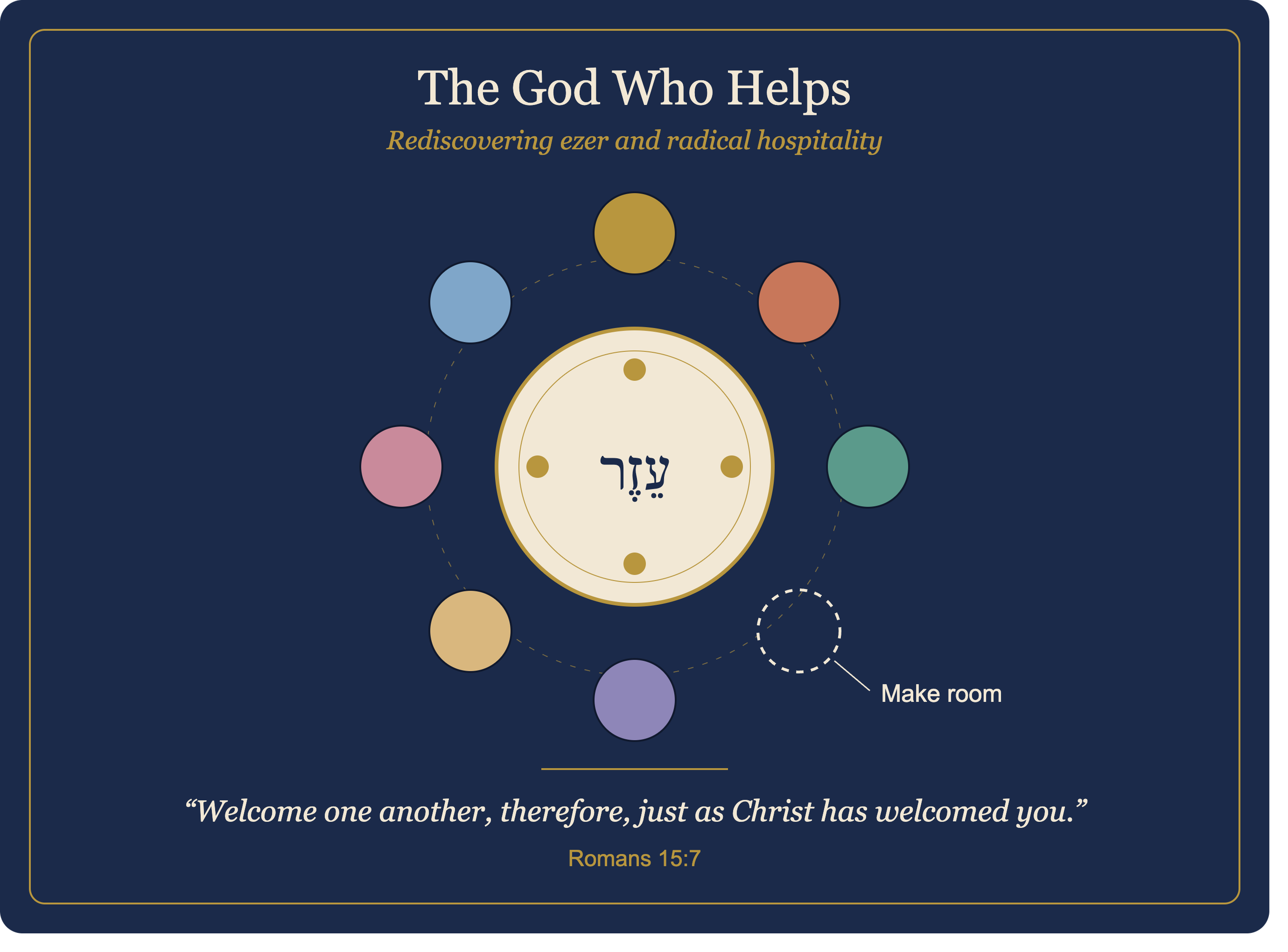
The God Who Helps
Rediscovering Ezer and the Christian Calling to Radical Hospitality
“It is not good that the man should be alone.” — Genesis 2:18
There is a quiet revolution hidden in one Hebrew word in Genesis 2: עֵזֶר, ʿezer, traditionally translated “helper.” For generations it has sometimes been read as though God assigned the woman a secondary role. But across the Old Testament, ezer is a word of strength, rescue, deliverance, and protection — and Scripture most often uses it of God Himself. That discovery reaches far beyond marriage. It tells us something about God, about Christian community, and about hospitality as a form of evangelism.
1. “It Is Not Good That the Man Should Be Alone”
Genesis 1 keeps repeating that creation is good: light, land, creatures, and finally humanity, “very good.” Then comes the first “not good.” Adam has a garden, meaningful work, animals, and God’s presence — yet something is missing. He is alone. We were created to give and receive love, to serve one another, and to share together in God’s mission. Christian faith therefore cannot be reduced to a private relationship with God; we are members of one body (1 Corinthians 12:12). The question is not only “Do I have faith?” but “Whom am I walking with — and who is walking with me?”
2. Ezer: The Helper Who Is Strong
The word ezer appears where help is urgently needed, and the Old Testament applies it to God:
“Our soul waits for the LORD; he is our help and shield.” — Psalm 33:20
“The God of my father was my help, and he delivered me from the sword of Pharaoh.” — Exodus 18:4
“I lift up my eyes to the hills — from where will my help come? My help comes from the LORD, who made heaven and earth.” — Psalm 121:1–2
So Genesis 2:18 cannot reasonably mean an inferior “assistant.” The ezer comes alongside, strengthens, protects, and helps another accomplish what cannot be done alone. True helping does not diminish a person; it empowers them to flourish. God’s help does not control us or humiliate us; it restores our humanity, gives us dignity, and enables us to become what God created us to be. That is the kind of community Christians are called to create.
3. Jesus and the Ministry of Coming Alongside
Paul makes this principle central to the church: “Bear one another’s burdens, and in this way you will fulfill the law of Christ” (Galatians 6:2). We rejoice with those who rejoice and weep with those who weep (Romans 12:15). That is ezer living. When someone weeps, we do not tell them to stop crying — we sit beside them. When someone falls, we do not stand over them in judgment — we reach out a hand. When someone is new, we do not ask whether they already belong — we make room. When someone is different from us, we see not a threat but another part of God’s beautiful creation.
Jesus embodied the God who helps. He came near — touching lepers, eating with outsiders, welcoming children, speaking with women, receiving foreigners, and stopping for people society ignored. When religious leaders questioned His table company, He answered, “Those who are well have no need of a physician, but those who are sick” (Mark 2:17). He did not wait for people to become acceptable before approaching them. We welcome people not because they have become like us, but because Christ has welcomed us.
Hospitality can also be evangelism. When Jesus entered the home of the despised Zacchaeus, He said, “Today salvation has come to this house” (Luke 19:9). The table became a place where barriers fell, trust grew, and the gospel could be heard. Many people suspicious of organized religion may never walk into a church, but they may come to dinner, a cultural celebration, or a language class — because someone invited them as a friend.
Across cultures, sharing food says: you are welcome here, you are safe here, you belong here, I want to know you. That is why Jesus’ ministry was filled with meals — with disciples, sinners, Pharisees, and crowds, and at the Last Supper — and why after His resurrection He kept meeting people around food and fellowship. A table changes the nature of a relationship.
4. Radical Hospitality: “Make Room”
“Do not neglect to show hospitality to strangers” (Hebrews 13:2). The New Testament word carries the idea of love toward strangers — not merely friends, or people who look like us. So we ask: Who is missing from our table? Who feels invisible, or lonely, or new to the country? Who speaks another language, belongs to another generation, is struggling economically, or has been hurt by Christians? Then comes the Christian response: make room. Jesus identifies with the stranger: “I was a stranger and you welcomed me” (Matthew 25:35).
Paul sets the standard: “Welcome one another, therefore, just as Christ has welcomed you” (Romans 15:7). Not after people become like us, but as Christ welcomed us — with our questions, failures, differences, and wounds. The church is not a club for the spiritually perfect; it is a community of people who have received mercy. And the gospel is not only something we announce but something we embody. Before people hear our theology, they experience it in how we treat them.
5. Welcome Without Losing Conviction
Radical hospitality does not abandon Christian conviction. Jesus sat at table with people who disagreed with Him, listened without fear, and loved without surrendering truth, extending grace while calling people toward transformation. We can make space for questions, welcome doubt, honor different cultures, and learn from experiences unlike our own — and still joyfully say, “Come and see what we have discovered in Jesus.” That is evangelism rooted in hospitality rather than pressure.
6. Becoming an Ezer Church
Imagine a congregation where the lonely find friendship, immigrants find welcome, children are heard, older adults are valued, different cultures are celebrated, people in poverty receive dignity rather than shame, and meals become ministry. Strangers are invited to the table, questions are welcomed, friendship becomes evangelism, and service becomes worship. Such a church asks not only “How can we get more people into our church?” but “How can we become people whom hurting and searching neighbors can trust?” Evangelism begins with people, not statistics; with relationships, not programs; with love, not attraction.
The traditional church says, “Come to us.” Jesus also went — entering homes, sitting beside wells, eating at unfamiliar tables. The Great Commission begins with “Go” (Matthew 28:19). So we cross cultural and language barriers, listen before speaking, and serve before asking. And when people ask why we care, we can answer: “Because Jesus has taught us to love our neighbors.”
7. You Do Not Have to Walk Alone
The Bible’s answer to loneliness is not better entertainment or greater individual achievement. It is relationship. God gives us one another. God becomes our Ezer. Christ comes alongside us, and the Holy Spirit forms us into one body. The church can become a place where people say, “I am seen here. I am heard here. I can bring my questions here. I have found friends here” — and eventually, “I have encountered Christ here.” The church does not need to become less Christian to welcome more people; the more deeply we know the God of Scripture, the more welcoming we become. Jesus can welcome without compromising His identity; so can we.
So let us open our tables, our homes, our churches, and our hearts. Let us listen to strangers until they become friends, and love until people grow curious about the source of that love. Be someone’s ezer: learn a name, hear a story, share a burden, welcome someone who feels like a stranger. When someone feels alone, may the church be able to say:
“You do not have to walk alone. We will walk with you.”
Because that is what our God has done for us. “My help comes from the LORD, who made heaven and earth” (Psalm 121:2). Our help comes from the Lord — and by God’s grace, we can become help for one another. Amen.
